BRDF
options.calc_directional & options.calc_ebal
Warning
This is an advanced topic, please refer to Schaepman-Strub et al. 2006 [4] for further explanations.
Definition
Light consists of two components direct (aka specular) and diffuse (aka hemispherical).
To explain reflectance of each light component individually, different reflectance factors are used.
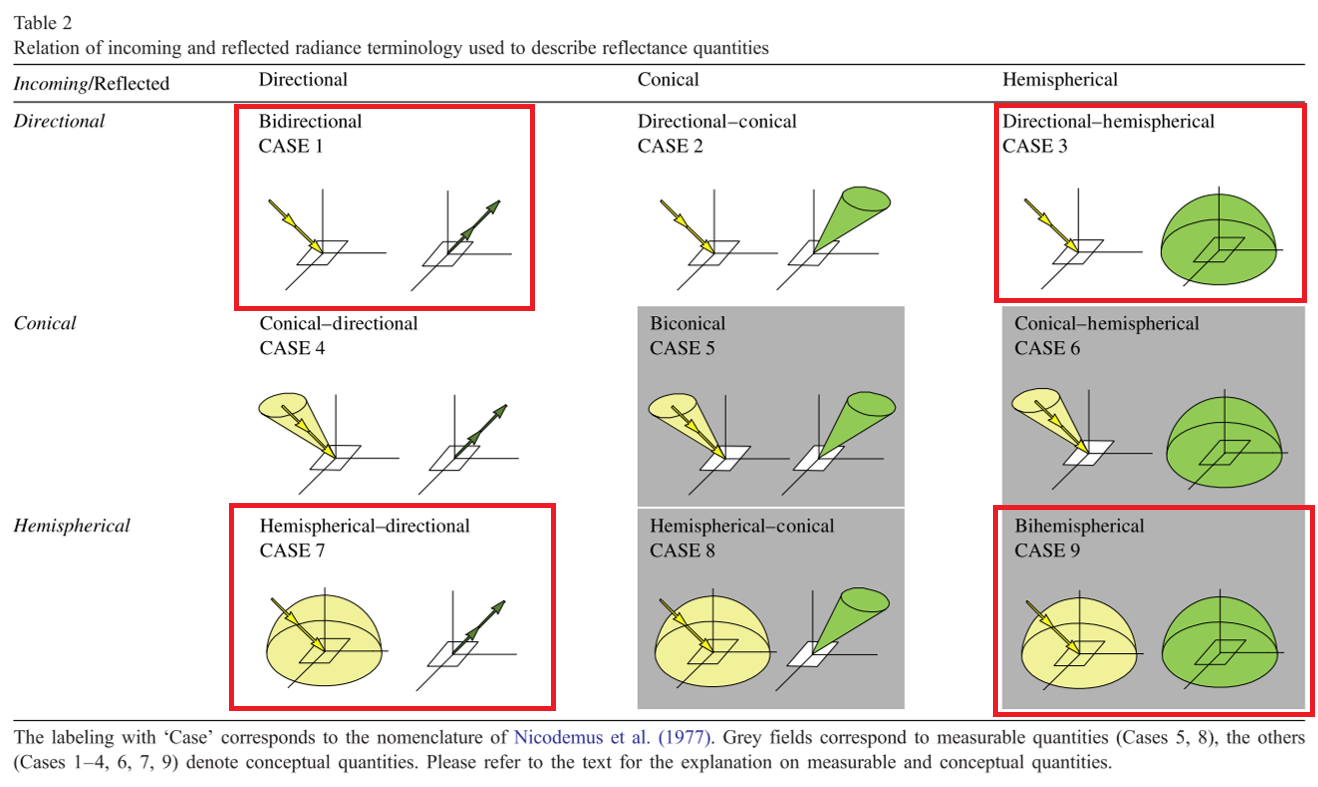
SCOPE model simulates the following reflectance factors:
- Incoming light is directional
CASE 1: bidirectional (BRF)
CASE 2: directional-hemispherical (DHRF)
- Incoming light is hemispherical
CASE 7: hemispherical-directional (HDRF)
CASE 9: bihemispherical (HRF)
After reflectance from a material direct component of incoming light contributes to both directional and hemispherical component of reflected light.
After reflectance from a material diffuse component of incoming light also contributes to both directional and hemispherical component of reflected light.
Note
Bidirectional Reflectance Distribution Function is a function describing bidirectional reflectance from a material.
“input” of BRDF are four angles (solar zenith and azimuth angle (direction of incoming light); viewing zenith and azimuth angle (direction of observation))
“output” of BRDF is reflectance (BRF)
SCOPE
To simulate BRDF enable options.calc_directional.
SCOPE calculates BRDF itself and also directional fluorescence radiance and directional thermal radiance (or brightness temperature).
Directional plots have 3 components:
viewing zenith angle (towards the centre of the circle)
viewing azimuth angle (around the circle)
measured quantity (color)
On all graphs you can see a hot spot (red dot) where viewing azimuth angle is 0º and viewing zenith angle is 30º.
Hot spot occurs when the observation direction coincides with the illumination direction. Indeed, for this example solar zenith angle of 30º was used.
Directional plots are made per wavelength.

Courtesy of Peiqi Yang