Spectra
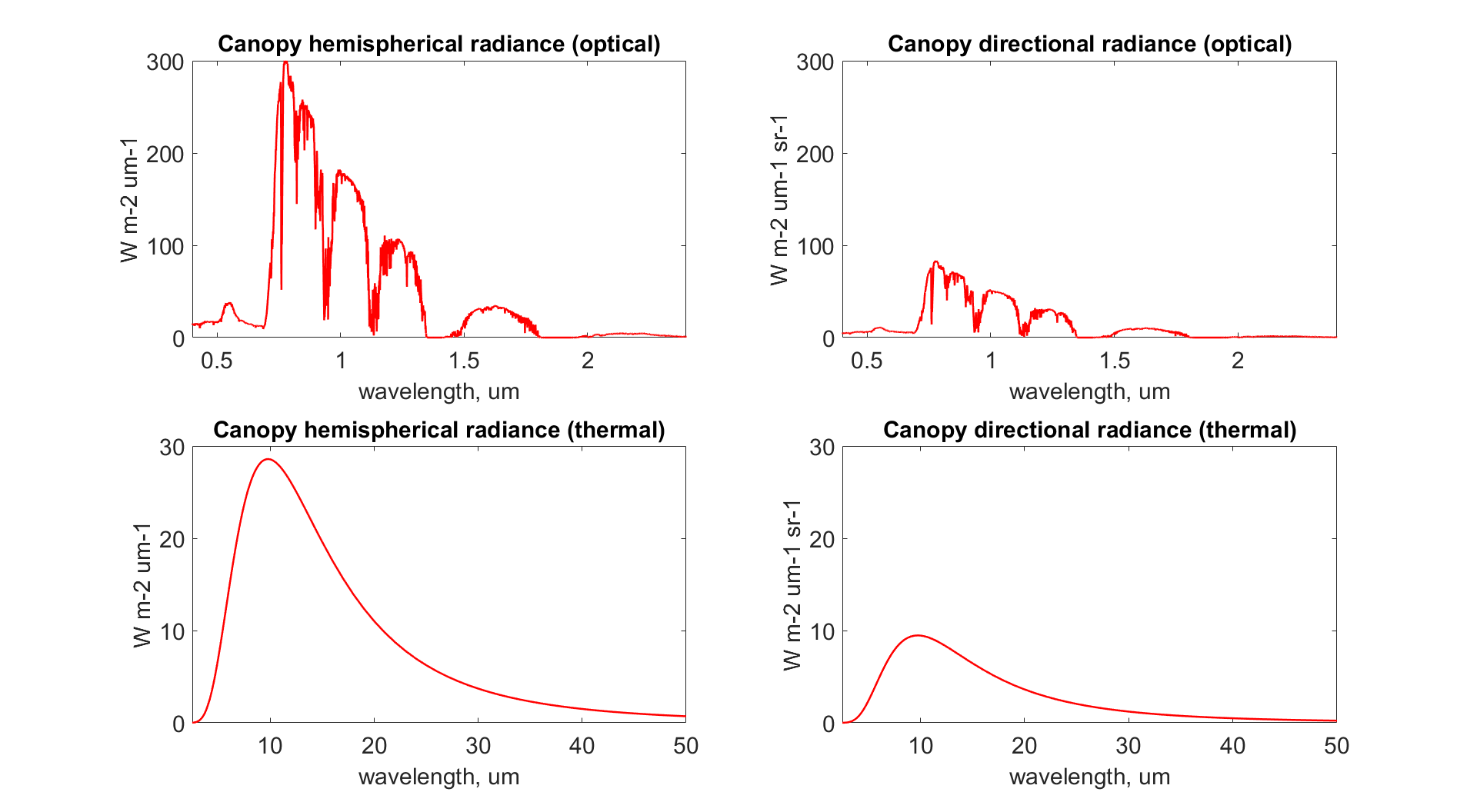
For thermal part radiance enable options.calc_planck & options.calc_ebal.
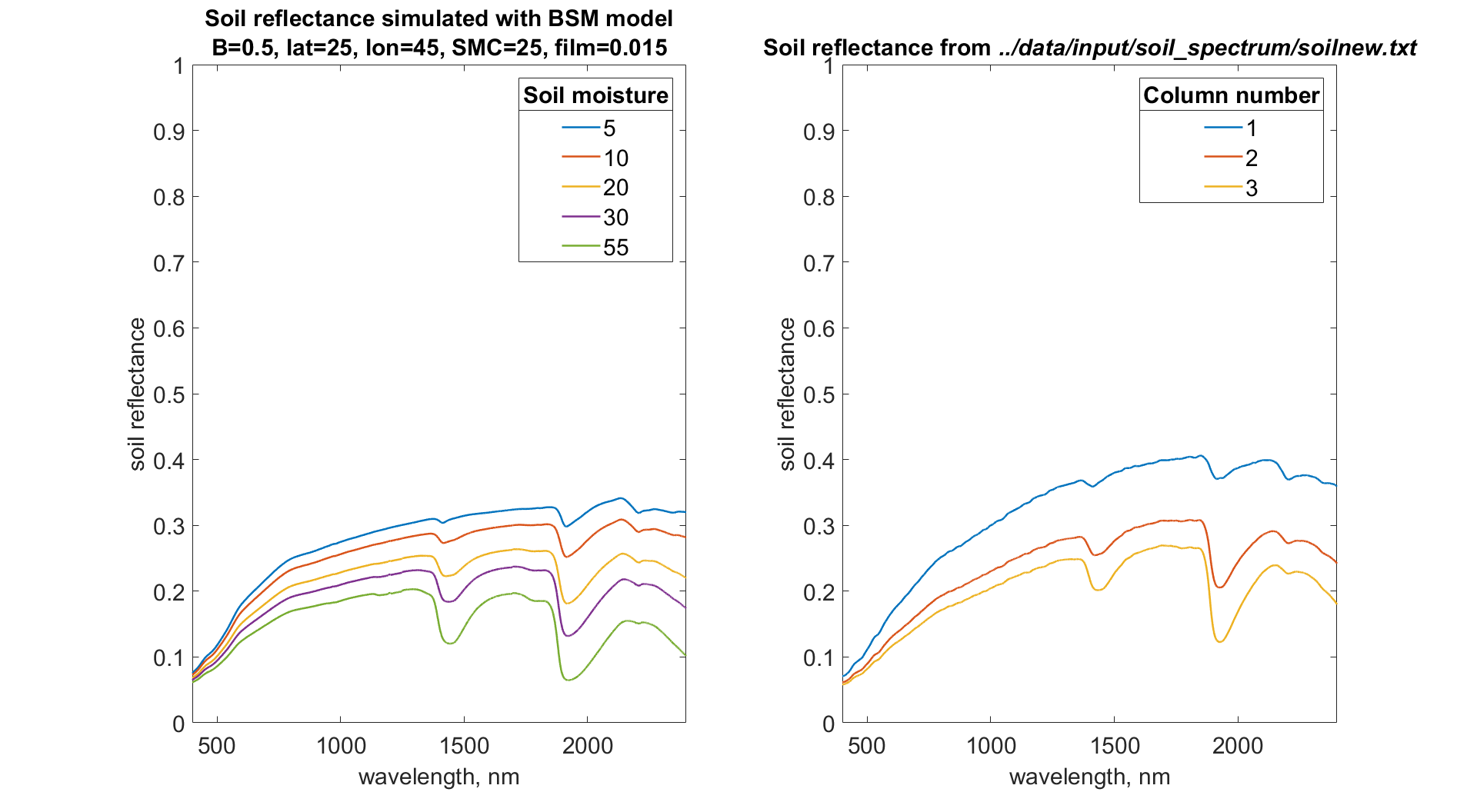
For soil reflectance simulation with BSM model enable options.soilspectrum
Definition
Optical part of spectrum takes into account the ability of objects (leaves, soil) to reflect the light.
Thermal part of spectrum is based on Planck’s law that is any object that has temperature above 0 K emits electromagnetic waves.
SCOPE model uses the theory of radiative transfer describing electromagnetic waves propagation and takes into account absorption and scattering.
There are 3 components in the model:
soil
leaf
canopy
SCOPE soil
SCOPE simulates soil reflectance (optical domain) with BSM() (if options.soilspectrum). Alternatively, a file with soil reflectance spectrum might be provided (several options are in ./data/input/soil_spectrum/soilnew.txt*).
On the graph you can see the difference.
SCOPE leaf
SCOPE model (in particular fluspect_B_CX_PSI_PSII_combined()) works similar to PROSPECT model and simulated leaf reflectance, transmittance and absorption (the rest). Bonus part is fluorescence.
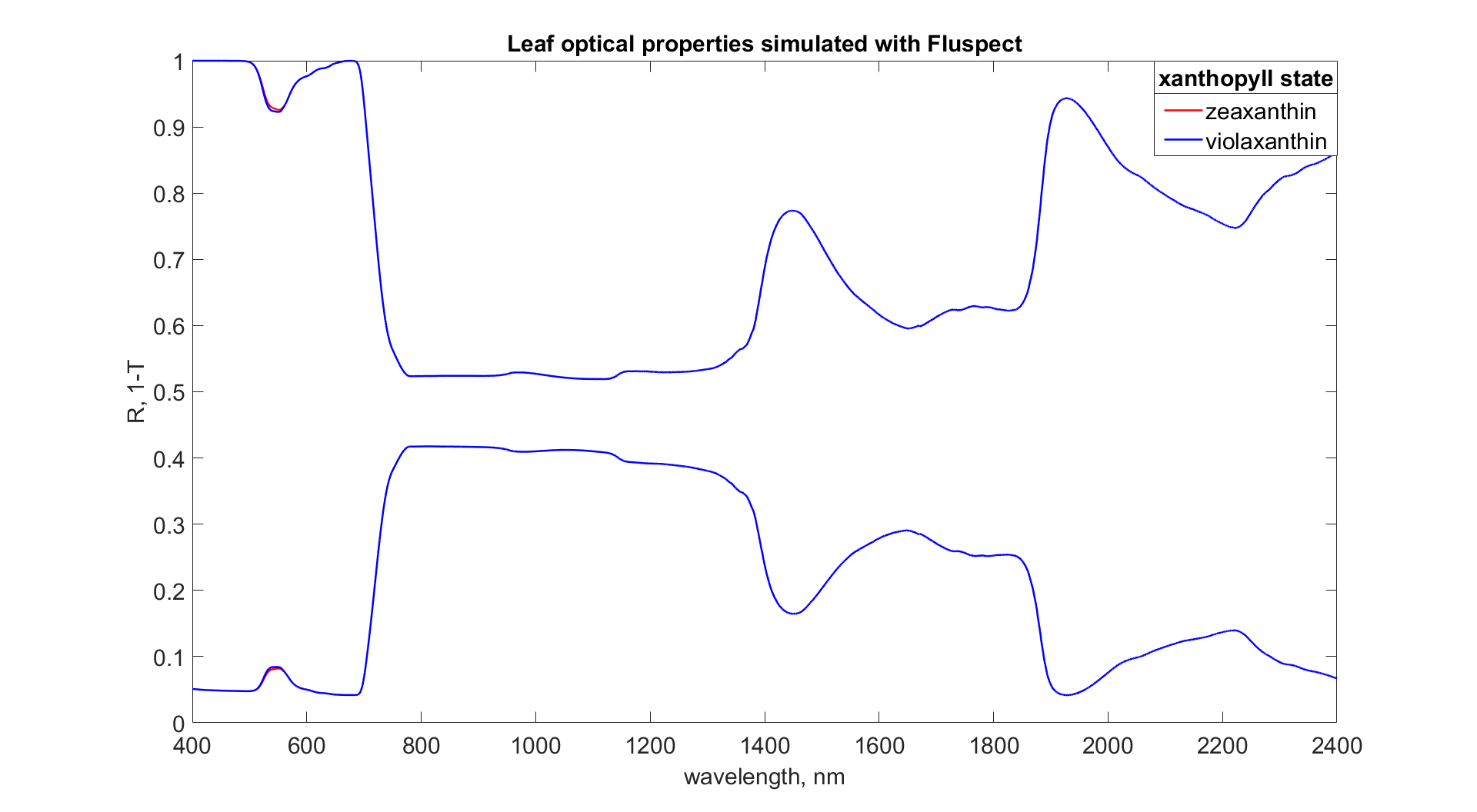
The other bonus is xanthopyll cycle, available with option.calc_xanthophyllabs, that you might see as a tiny pick around 500 nm.
Note
We do not have a model for leaf reflectance in the thermal domain. Have a suggestion - write to us Support
SCOPE canopy
SCOPE represents canopy as 60 elementary layers of leaves of two types: sunlit (then we account for leaf inclinations) and shaded.
Leaf and soil optical properties are taken into account here.
Optical properties are calculated by RTMo() and thermal properties by either RTMt_planck() then the output is radiance (as on the graph) or RTMt_sb() - only integrated fluxes.
Note
default configuration uses Stefan-Boltzmann’s law (RTMt_sb()) that will output spectrally integrated thermal fluxes instead of per wavelength, in this case:
integral of hemispherical thermal radiance is 432.5 W m-2
integral of direct radiance 140.4 W m-2